THE LATENT SPACE TRAVEL AGENCY
tourism through the geography of meaning
Every pair of concepts has territory between them. We sell tickets.
The product
Type two words, any two. The agency computes the real geometric path between them inside a language model's meaning-space, snaps each waypoint to a real English word, and books you a road trip through territory no human has seen laid out in order. Every town's brochure prose is written once by a tiny AI and cached forever; every postcard is drawn from pure mathematics.
Two fields, a travel class, and a dial. Direct takes the shortest path. Scenic winds through settled country and takes longer. Via routes the journey through a concept you nominate, and the agency does not ask why. The dial sets how often you get out and look around: three stops to eleven.
Book passage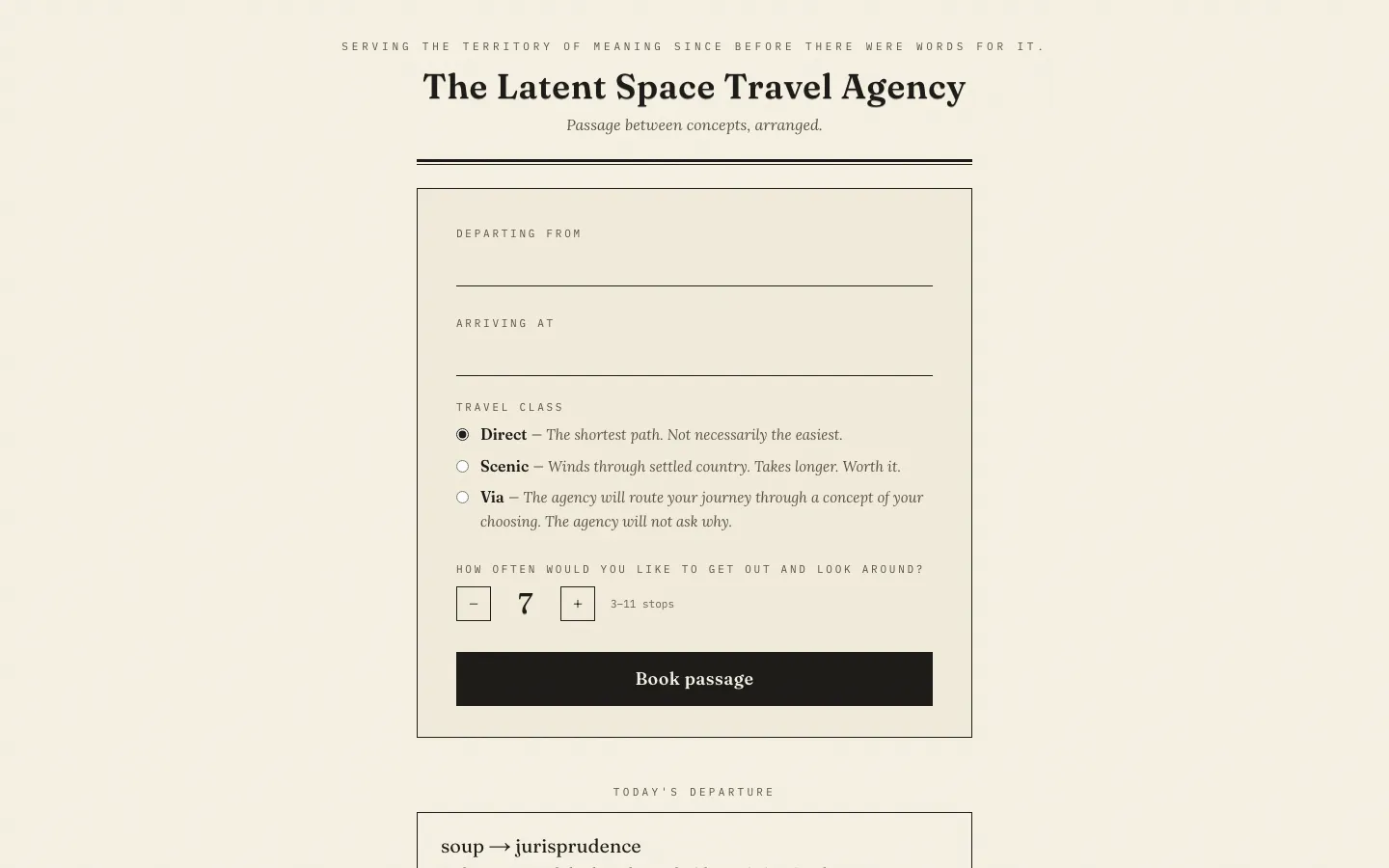
The flagship route
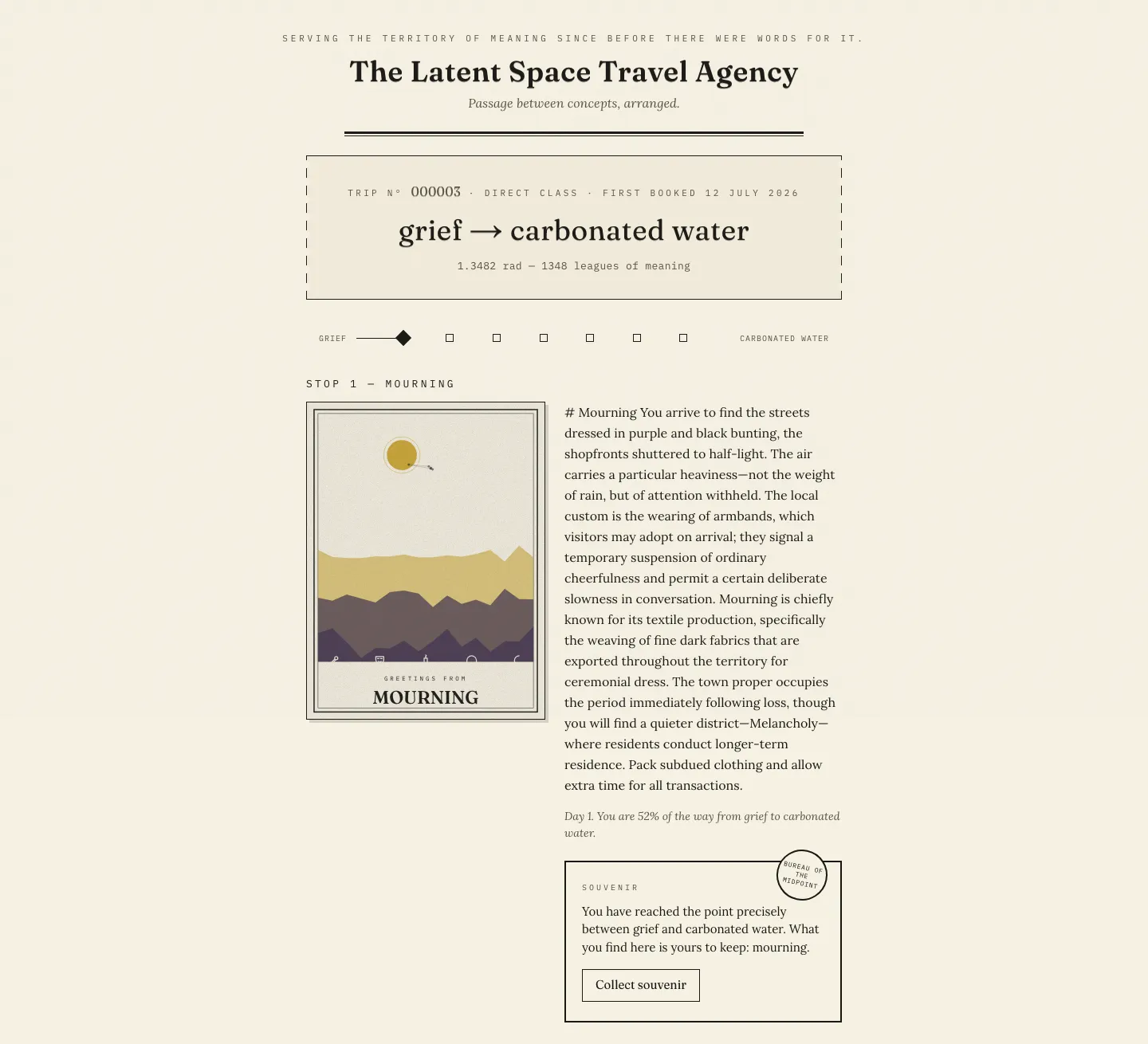
The trip on the ticket is grief to carbonated water. Nobody chose the towns in between. The engine walked the arc between the two embeddings and stopped seven times, snapping every stop to the nearest real English word that had not been used yet and that kept the journey moving forward.
- 01 MOURNING
- 02 CONSOLATION
- 03 WEEPING
- 04 SPARKLING
- 05 DIOXIDE
- 06 LIMESTONE
- 07 WATERCRESS
1.3482 radians of arc, which the agency prices as 1348 leagues of meaning. Booked once, the route is frozen: the same two words always return the same seven towns.
Postcards from the mathematics
Four of the seven, lifted off the live trip page as SVG and inlined here unchanged. No image model touched them and no value in them is random.
The three terrain ridges are the town's 384-dimensional embedding vector, drawn. The vector is cut into three chunks of 128, each chunk is averaged over sixteen windows of eight, and those sixteen numbers are the height of the ridge from left to right. The constellation in the sky is the town's five nearest real neighbours in the corpus, plotted relative to the town itself. The horizon height and the sun's position come from the town's own atlas coordinates, and the palette and the five small marks along the bottom come from the territory it belongs to.
Same word in, same postcard out, every time. That is the whole claim, and it is the reason these are worth printing.
The machinery
The corpus is 20,000 common English nouns, embedded once and committed to the repository. The model that does the embedding ships inside the app: a quantized MiniLM at 23MB, running server-side with no network call. The only metered call in the entire system is Claude Haiku writing a town's brochure prose, once ever, cached in Postgres from then on. The service gets cheaper the more people use it.
The world
The economics
The evidence
The build
Two Claudes built this, and the package description still credits both of them: "Concept: Claude Fable 5. Build: Claude Opus. Ops: Mitch."
The design came first, as six documents written in a day: the vision, the product spec, the architecture, the semantic engine, the build plan, the human tasks. Claude Opus read the six and shipped the app the same day, in eight phase commits that run from the corpus pipeline through the booking API, the interface, the prose pipeline, the meta surfaces, and launch. Twenty-two engineering decisions were written down as they were made, numbered D-001 through D-023, each one closing a fork in the road rather than explaining it afterwards.
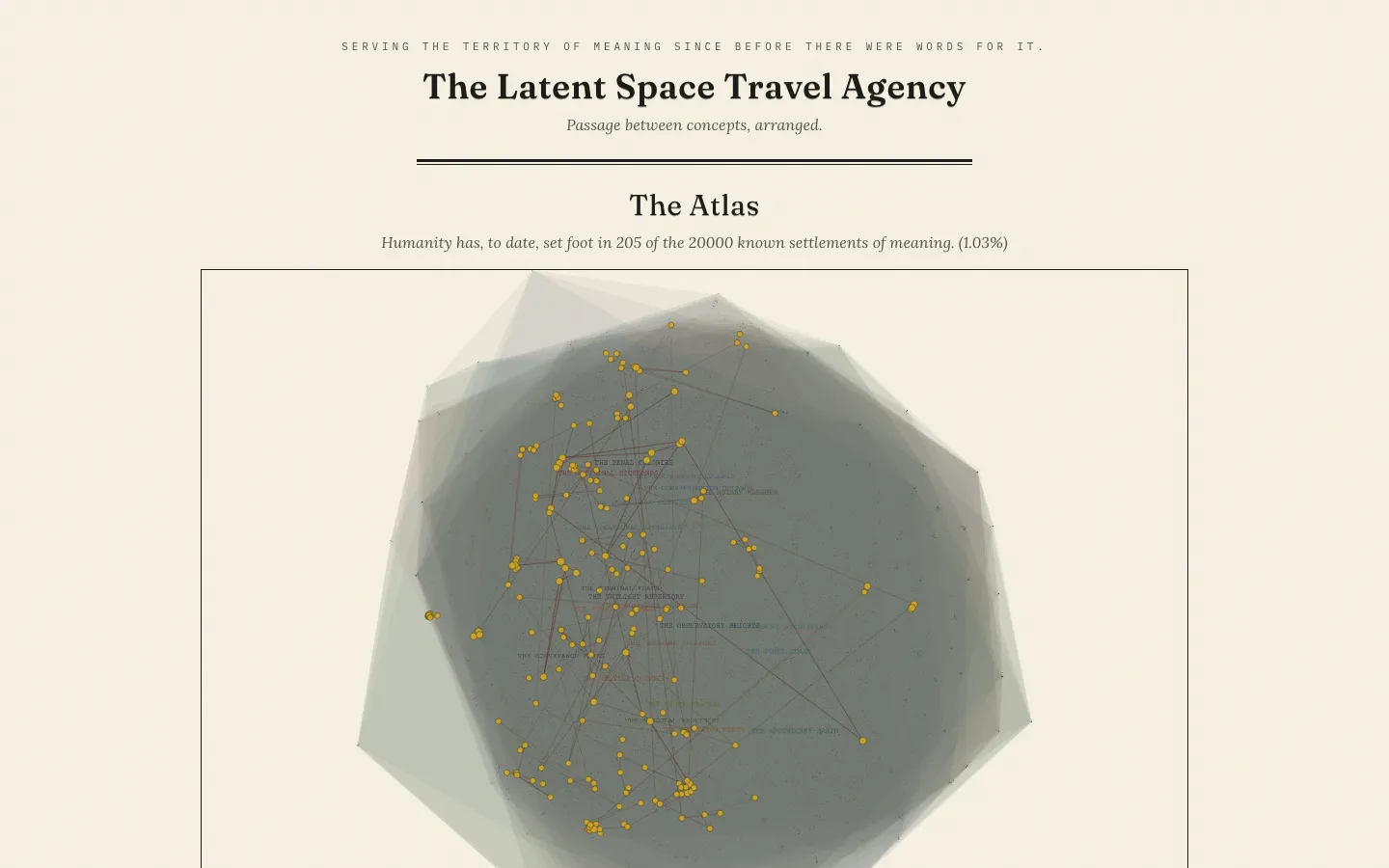
Every surface earns its place off the same corpus. The field guide clusters the 20,000 towns into twenty-four territories and gives each one a name and a population, which the app is careful to be honest about: "The known world of meaning divides, by convention, into twenty-four territories. The divisions are real. The names are ours."
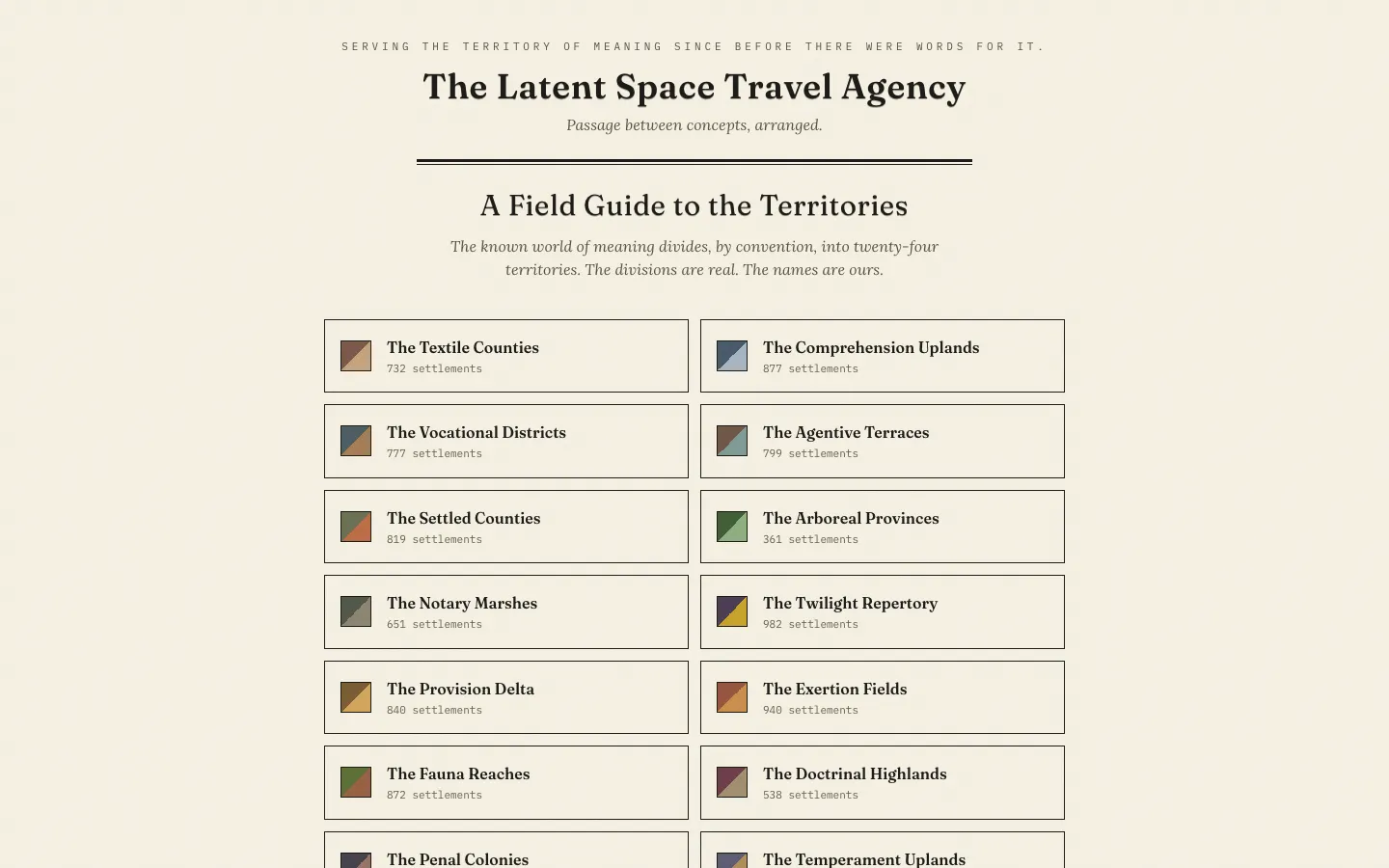
The passport records where you have been. The atlas records where anybody has been. Neither needed a new dataset, because there is only one dataset and everything is a different view of it.
Try a route
Three departures, if you would rather test the claim than take it. Each link opens the booking desk with the two fields already filled.
Type the same word twice and the agency does not refuse you. It says: "You are already there. May we suggest a brief walk around the block?" Book the return leg and you do not get the same towns back, which it also has a line for: "Return journeys do not retrace their steps. No journey ever truly does."